
Taliaferro ICE Custody Handoffs
An immigration detainer is a request tied to possible immigration custody. It does not turn every Taliaferro arrest into an ICE case. Ask the sheriff or receiving jail whether the person left on a local release, transferred to another criminal-justice agency, or entered ICE custody. The county release log should identify the destination or hold agency when recorded.
The official ICE Online Detainee Locator System is the correct current-custody search. USA.gov guidance explains two routes: search by A-number and country of birth, or use name, country of birth, and birth date. Exact spelling matters. Some people may not appear at once, and minors are not searched through the same public process.
A blank result does not prove release. The person may be newly transferred, entered under different biographical data, outside searchable ICE custody, or held by another agency. If ICE custody is confirmed, immigration court case status is a separate source for hearing and case information. It does not replace the detention locator.
ICE release can mean release from immigration detention under conditions, removal from the United States, or transfer within the immigration system. Ask ICE for the specific status. A Taliaferro court disposition explains the local criminal case but does not determine the immigration outcome.
Official ICE Search Fields
The USA.gov ICE detainee guide documents the official search routes and the identifiers required to check current immigration custody.
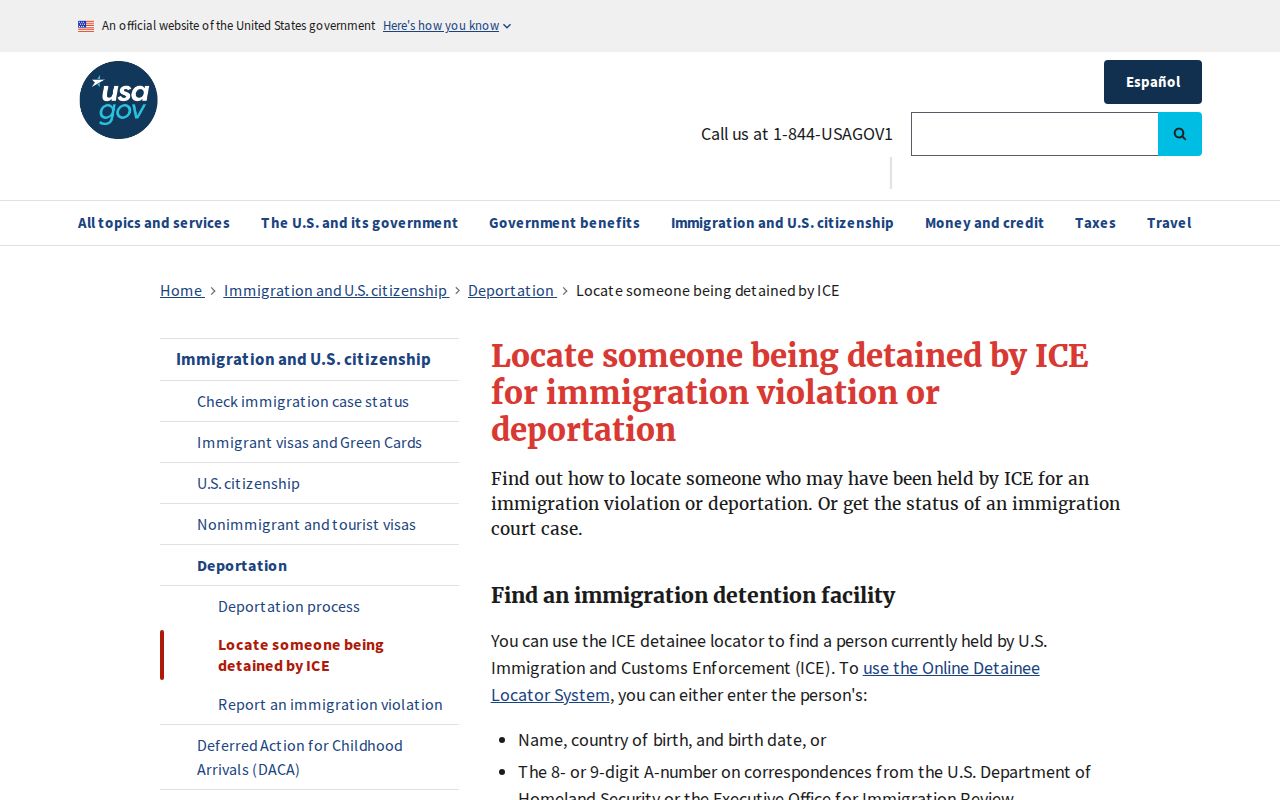
The source view reinforces that an A-number search and a biographical search use different fields, and both concern ICE detention rather than county release records.
Search ICE Detainee Records
The locator offers two main search routes. Use the A-number with country of birth when the immigration identifier is known. Otherwise use the person's exact name, country of birth, and birth date. Spelling and name order matter, so compare the result with reliable identifying information.
- Open the official ICE locator.
- Select the A-number or biographical search.
- Enter every required field.
- Review the matching custody result.
- Record the facility or contact path shown.
- Confirm the status with ICE when formal proof is needed.
A current ICE result does not explain the Taliaferro criminal case. Obtain the sheriff release entry and court disposition separately.
ICE Release Versus Removal
“Released” can describe several immigration outcomes. A person may leave detention under conditions, transfer to another facility, enter another agency's custody, or be removed from the United States. The locator is mainly a current-detention tool, so an absent record does not identify which event occurred.
Ask for the exact custody event and destination. A county jail release to ICE is a transfer. An ICE facility transfer is continued immigration custody. Release under immigration conditions is different from removal, and each has a different official record.
| Event | What it means |
|---|---|
| Local release to ICE | Transfer into immigration custody |
| ICE facility transfer | Continued ICE detention elsewhere |
| Release under conditions | Out of detention with immigration obligations |
| Removal | Immigration enforcement departure |
Taliaferro Detainer Record Path
An ICE detainer is tied to possible immigration custody, but it does not prove that ICE ultimately accepted the person. Ask the Taliaferro sheriff or receiving jail whether a detainer existed, whether it remained active, and which agency received the person at release.
The local court order can explain the criminal-case result. It cannot decide immigration status. Conversely, the ICE locator cannot replace the county discharge entry. Read both records to distinguish the end of local custody from the start of immigration detention.
When ICE Shows No Record
A blank locator result has several possible causes. The person may be newly booked, entered under a different spelling, not searchable through the public system, already released, transferred to another sovereign, or never taken into ICE custody. Retry with the correct identifiers before drawing a conclusion.
Contact the arresting sheriff for the local destination. Check BOP for a sentenced federal prisoner and USMS for federal pretrial custody. If the issue is an immigration court case rather than physical custody, use the immigration court case-status route described by USA.gov.
Note: No locator match is not proof that a person entered the community or that an immigration case ended.
ICE Custody Record Verification
Save the A-number, exact name used, search date, and facility shown. Those details help ICE locate the right custody event. Ask for a current detention location, transfer, release from detention, or removal record rather than a vague “release record.”
For the Taliaferro side, request the sheriff or receiving jail discharge entry, transfer destination, and hold agency. For the legal reason the local case ended, request the court order. Each office should verify only the record it created.
ICE and Federal Custody Boundaries
ICE immigration detention is separate from BOP sentenced custody and USMS pretrial detention. A person can move between those systems, but the locator changes with the responsible agency. BOP's past release date concerns BOP custody. A USMS jail exit can be a transport. ICE then controls only the immigration detention stage.
This boundary is especially important for Taliaferro because there is no current primary county jail. The physical receiving jail may be outside the county, and the eventual federal or immigration agency may be different again. Track the person by agency and date, not by county name alone.
Taliaferro ICE Timeline Checks
Build a timeline when a Taliaferro arrest leads to immigration custody. Start with the local arrest and receiving jail. Add the court disposition, jail exit code, any detainer or hold, and the agency that accepted custody. Then add the ICE locator result and the date it was checked.
This prevents two common errors. The end of the criminal case does not end immigration detention. Disappearance from the ICE locator also does not explain whether the person was released under conditions, transferred, or removed. Each transition needs its own source.
If a record changes, keep the old search date and verify the new status with the responsible office. Custody systems update at different times, so resolve a short lag through agency contact rather than guesswork.
ICE Locator Identity Matching
Identity matching is central to an ICE search. An A-number is more precise than a name, but it must be paired with country of birth in the locator route described by USA.gov. A biographical search needs the exact name, country of birth, and birth date. Name order, spelling, and multiple surnames can affect results.
Do not use a result until the public details fit the person. If no match appears, verify the data with a reliable record and try the correct route. A blank result can reflect timing or search limits, not release. ICE contact is the next step when current custody is strongly supported by the sheriff or receiving jail.
Keep private identifiers out of public notes. Record only what is needed to route an official inquiry. The source agency should confirm the person and custody status.
After ICE Detention Ends
The end of ICE detention can lead to conditional release, removal, or another agency's custody. The locator may no longer display a current detention result after any of those events. It does not provide one universal historical explanation.
For conditional release, immigration case records and ICE documents explain ongoing obligations. For removal, request the appropriate immigration record. For a criminal-custody transfer, follow the receiving sheriff, USMS, or BOP system. The Taliaferro court file remains limited to the local case.
Ask one precise question at a time: Was the person released from detention, transferred, or removed? On what date? Which office created that record? Clear questions keep a local jail discharge from being mistaken for the end of all custody.
When a family or legal contact needs a firm answer, note the precise point in the custody chain that remains unknown. The Taliaferro sheriff can identify the receiving jail. That jail can identify an ICE handoff. ICE can address immigration detention, while the immigration court system addresses case status. A person may have records in all four places, but none replaces the others. Check dates and agency names closely. If the locator result changes, preserve the earlier check date and seek the agency document that explains the change. This approach is more reliable than treating a missing current record as proof of community release, and it respects the difference between local criminal custody and federal immigration detention.
Note: An ICE locator change should be confirmed through the immigration custody source before it is described as release.