
BOP Locator Search Fields
The BOP locator searches sentenced federal custody from 1982 to the present. A register number is the strongest key. Name, age, race, and sex can narrow a biographical search. Compare every available identifier before treating a result as the Taliaferro-connected person.
A listed facility indicates current BOP placement. BOP says a past release date with no facility means the person is no longer in BOP custody. That does not prove release to the community because another agency may receive custody.
| Field | Meaning |
|---|---|
| Register number | Federal prisoner identifier |
| Facility | Current BOP placement |
| Release date | Current BOP calculation |
How to Search BOP Releases
Confirm the case is federally sentenced before searching. A federal warrant or USMS hold may not yet produce a BOP record.
- Open the official BOP locator.
- Search by register number when known.
- Otherwise use name and identifying fields.
- Compare every public identifier.
- Read facility and release date together.
- Request BOP or court records for formal proof.
A blank result can reflect spelling, pretrial status, an older record, or custody outside BOP. It does not prove release.
BOP Release Date Changes
BOP warns that release dates may change after sentence recalculation. A federal court can amend the judgment, and prior-custody credit can be corrected. Another lawful hold may affect the destination even when the BOP term ends.
Georgia parole, a state TPM, and county earned-time rules do not control a federal sentence. The federal judgment states the term, while BOP administers its sentence calculation.
After Federal BOP Release
Leaving BOP may lead to federal supervised release, another agency's custody, immigration detention, or the community. Federal supervised release comes from the federal court and is not Georgia parole.
If ICE takes custody, use the ICE locator. If a state or county hold exists, identify that receiving agency. The federal docket explains the judgment and supervised-release term, while BOP documents its custody status.
BOP Record Verification
For an official answer, preserve the register number and request the relevant BOP or federal court record. Ask for a release date, sentence computation, facility history, or release event with a clear date range.
Taliaferro sheriff records can prove a local transfer to federal authorities. They cannot establish the later BOP calculation. Follow the chain through USMS and federal court to BOP placement or release.
Taliaferro Federal Custody Handoffs
A person arrested in Taliaferro County does not enter BOP custody merely because a federal agency is involved. The U.S. Marshals Service normally controls federal prisoners from arrest through court and transport. BOP becomes the main locator after a federal sentence and designation to a federal institution. During the pretrial stage, a county or contract jail may physically hold the person even though the federal government controls the case.
The official BOP Inmate Locator covers federal inmates from 1982 to the present. Search by register number when known, or use name and identifying information. Compare the result carefully. A facility name indicates current BOP placement. The BOP records explanation says that a past release date with no facility means the person is no longer in BOP custody.
“No longer in BOP custody” is narrower than “free in the community.” The person may have completed the BOP term, moved to supervised release, entered another sovereign's custody, or been transferred for immigration action. Check the federal court docket and the receiving agency when the destination matters. BOP also warns that release dates can change after sentence recalculation.
For an older or official federal record, request the underlying BOP or court document. A locator result is useful for verification, but the judgment, sentence computation, and release record answer different questions.
Federal BOP Locator View
The official BOP inmate locator provides the federal search interface used for a current or released sentenced prisoner.
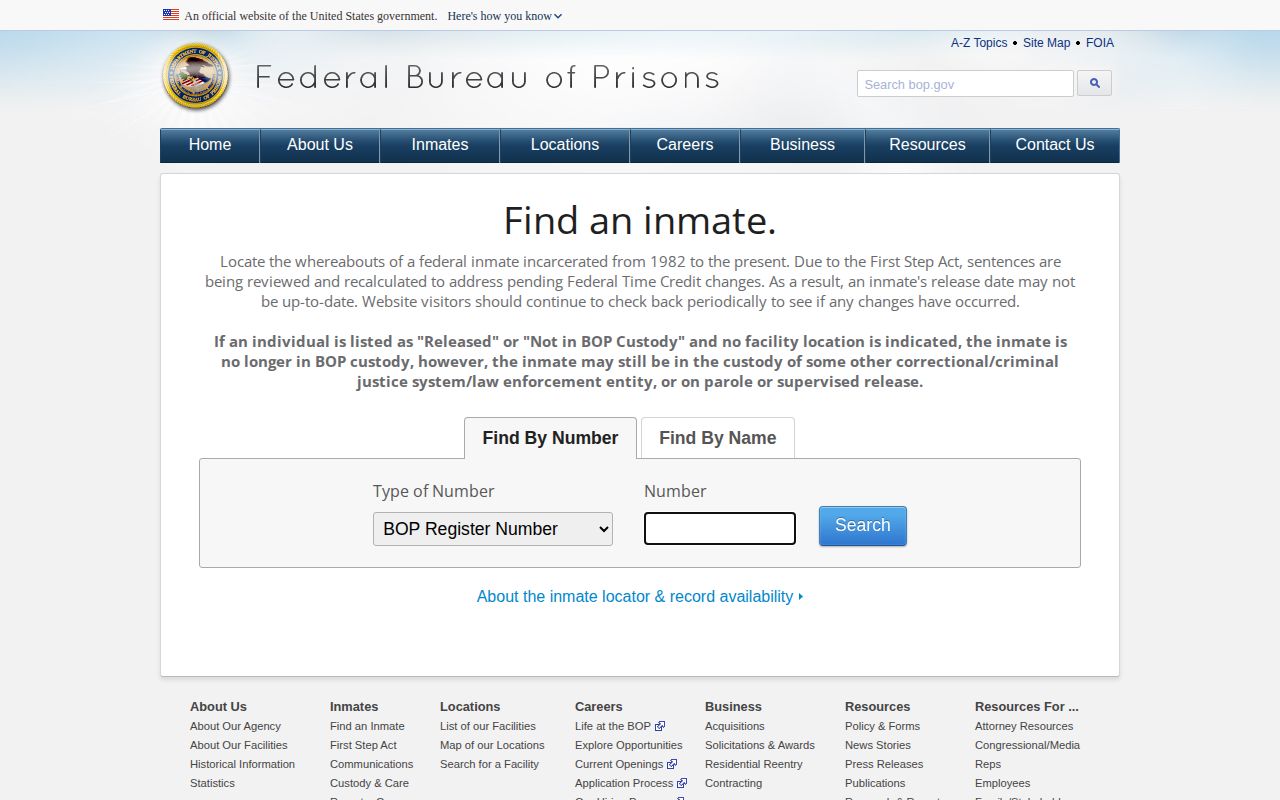
The locator view supports a federal sentence search, while the court and BOP records office remain the sources for formal sentence and release proof.
BOP Facility and Release Records
A BOP facility name shows the institution responsible for the current federal sentence record. It is not proof that the person has always been housed there. Transfers can occur while the register number and federal sentence remain the same. For a location history, request the agency record instead of assuming the current facility was the place of admission or release.
At release, note whether the locator still displays a facility. BOP's own explanation ties a past date with no facility to being outside BOP custody. If the date is future, treat it as subject to recalculation. If another agency has the person after that date, describe the event as leaving BOP and entering the receiving agency's custody.
Federal supervised release is not physical detention and does not appear as a BOP facility. The federal judgment sets that term, and federal probation handles it. A state parole record is not a substitute.
Taliaferro Federal Case Sources
A local sheriff record can show that a Taliaferro arrest was transferred for federal action. The federal court docket then shows detention, plea, judgment, sentence, and later orders. USMS controls much of the pretrial transport. BOP holds the sentenced-custody record after designation.
Build the timeline in that order. Record the local exit date, federal case number, sentencing date, BOP register number, designated facility, and current release field. If dates conflict, ask the office that created each entry to verify its part. Do not force a local discharge date to match the start of BOP custody because transport and court processing can fall between them.
This sequence explains why Taliaferro County may not appear in the BOP facility field. Federal institutions serve broad regions, and conviction location is not prison location.
BOP Search Result Interpretation
Read a BOP result as a federal custody record, not a complete account of the underlying case. The register number ties the person to BOP. The facility identifies current placement when shown. The release date reflects the current federal calculation, which BOP warns can change. A past date and no facility indicates that BOP no longer has custody, but another agency may still hold the person.
Compare the locator with the federal judgment. The judgment states the sentence imposed by the court. BOP administers the sentence and computes the date in its system. If the records differ, request clarification from the office that owns the disputed entry. A county sheriff cannot correct a BOP computation, and BOP cannot change a Taliaferro sheriff release log.
For a Taliaferro-connected federal prisoner, preserve the local arrest or transfer record as the first link in the chain. Then use the federal case number, register number, BOP institution, and release field. This method separates the local event from federal sentenced custody.
BOP Release Destination Checks
The destination after BOP matters. Federal supervised release places the person under federal court supervision in the community. An ICE handoff begins immigration detention. A state or county warrant can produce another custody transfer. None of those outcomes is Georgia parole.
Ask whether BOP released the person to the community or delivered the person to another agency. If the locator no longer shows a facility, check the federal docket and the suspected receiving agency. For ICE, use the official detainee locator. For a local hold, contact that sheriff or jail. Document the date each source was checked because custody can change quickly.
An official release record should identify the custody event and date. A locator screenshot shows what the public system displayed, but an agency response or federal court record provides stronger proof when the exact destination is important.
For older federal cases, the public locator's coverage begins in 1982. Records outside that range may require an archive or agency request. Even within the range, search results should be matched with the federal case and register number. A common name can return several people, and a release date alone is not enough to identify the right person. When asking BOP for verification, state the exact field that needs confirmation and the date on which the public result was viewed. If the issue is the sentence itself, direct the question to the federal court. If the issue is the custody calculation or institution history, direct it to BOP. This division of responsibility keeps the result accurate and prevents state or local rules from entering a federal calculation.
Note: Confirm both the BOP facility field and release-date field before describing federal custody as ended.